> For the complete documentation index, see [llms.txt](https://sdk.chorus.one/llms.txt). Markdown versions of documentation pages are available by appending `.md` to page URLs; this page is available as [Markdown](https://sdk.chorus.one/our-products/staking-dapp/unstaking-and-withdrawing.md).
# Unstaking & Withdrawing
How a staker unstakes a position and withdraws ETH, SOL, or GRAM back to their wallet.
Unstaking returns a staker's assets to their wallet. It is a two-part process on every network: the staker first requests to unstake, then withdraws once the funds are available. As with staking, every transaction is signed in the staker's own wallet.
The dApp is at [staking.chorus.one](https://staking.chorus.one/eth/stake); the staker opens the dashboard for the asset they want to unstake.
## Step 1: Request unstake
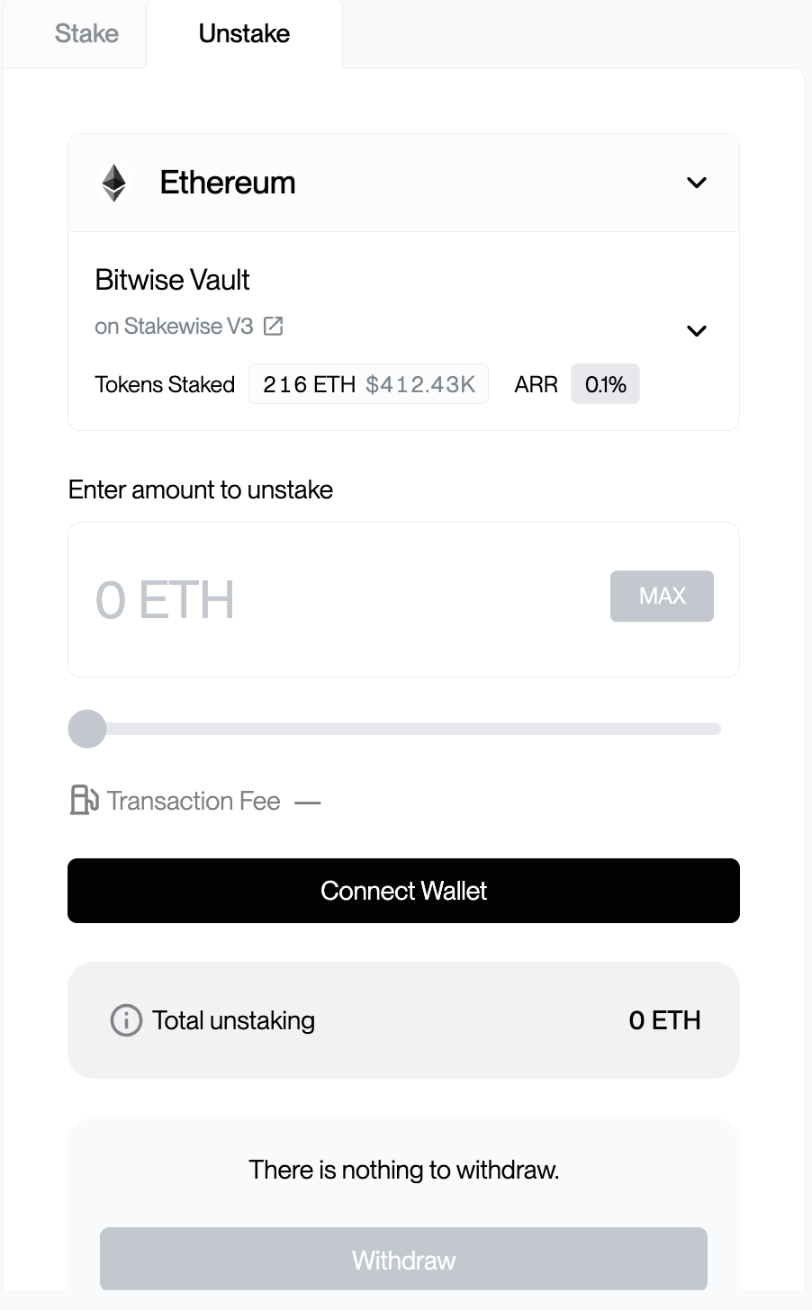
The staker connects the wallet holding the staked position, selects the asset, and enters the amount to unstake. Selecting **Unstake** and approving the transaction in the wallet submits the request.
Depending on the network, the assets may enter a short exit or unbonding window before they can be withdrawn.
Requesting an unstake (test environment; all figures shown are test data)
Exit timing depends on each network's own unbonding/withdrawal mechanics and current conditions. As a guide:
| Asset | Typical time to withdrawable |
| -------- | ------------------------------------------------------------------------------------- |
| **ETH** | At least 24 hours, and up to the length of the network's active exit (unstake) queue. |
| **SOL** | 2–3 days (one full epoch) |
| **GRAM** | Approximately 36 hours |
{% hint style="info" %}
The dApp shows the status of the request and when funds become available to withdraw.
{% endhint %}
## Step 2: Withdraw to the wallet
Once the unstake request has cleared and the funds are marked as available, the staker returns to the dApp, selects **Withdraw**, and approves the withdrawal transaction in the wallet.
The assets are then returned to the staker's connected wallet address.
{% hint style="success" %}
Once the withdrawal transaction confirms on-chain, the assets are back in the staker's wallet.
{% endhint %}
## Notes
* A staker can unstake any portion of a position; the full amount does not have to be exited at once.
* Rewards accrued up to the point of unstaking are included in the balance.
* When the dApp runs inside a supported host with an approved WalletProfile, the unstake and withdraw prompts are handled by the host's own signing UI. See the [Integration guide](/our-products/staking-dapp/integration-guide.md).
---
# Agent Instructions
This documentation is published with GitBook. GitBook is the documentation platform designed so that both humans and AI agents can read, navigate, and reason over technical content effectively. Learn more at gitbook.com.
## Querying This Documentation
If you need additional information that is not directly available in this page, you can query the documentation dynamically by asking a question.
Perform an HTTP GET request on the current page URL with the `ask` query parameter, and the optional `goal` query parameter:
```
GET https://sdk.chorus.one/our-products/staking-dapp/unstaking-and-withdrawing.md?ask=&goal=
```
`ask` is the immediate question: it should be specific, self-contained, and written in natural language.
`goal` is optional and describes the broader end goal you are ultimately trying to accomplish on behalf of the user. GitBook uses it to tailor the answer towards what is most useful for that goal.
The response will contain a direct answer to the question and relevant excerpts and sources from the documentation.
Use this mechanism when the answer is not explicitly present in the current page, you need clarification or additional context, or you want to retrieve related documentation sections.